Table of contents
What Are Incognito Lingual Braces?
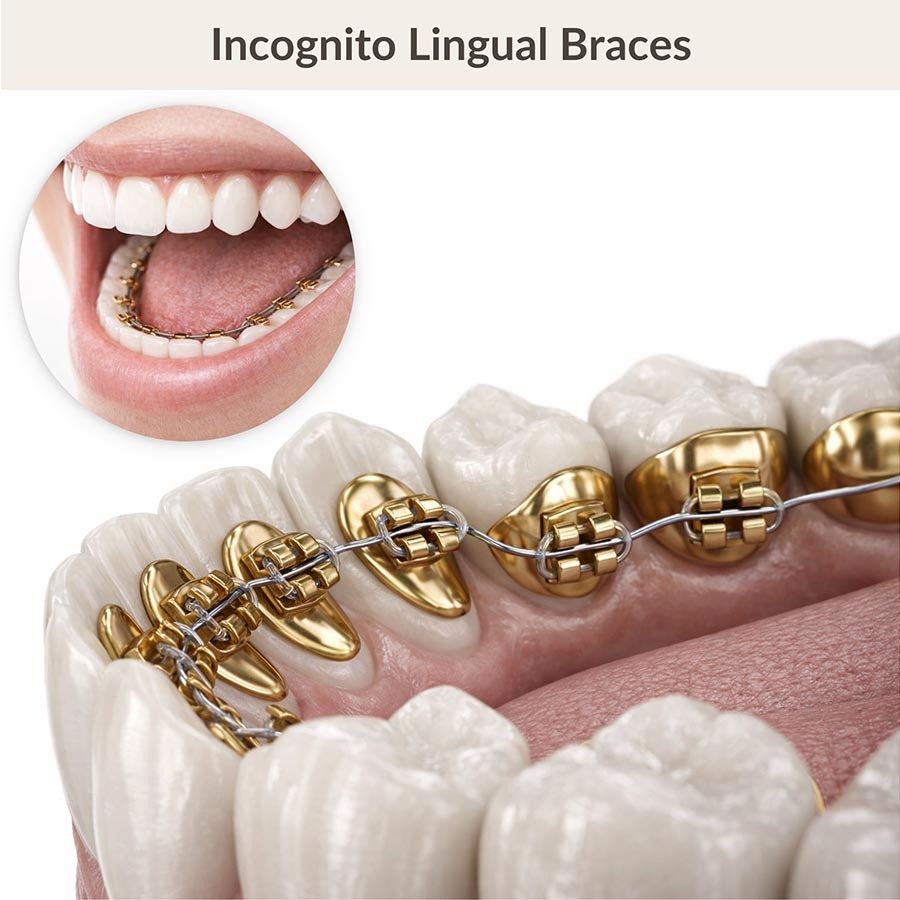
Most fixed orthodontic braces are designed to fit on the outer surfaces of teeth, but Incognito lingual braces are different.
Instead, the custom-made brackets are designed to fit on the inner surfaces of your teeth, making your treatment more discreet. The brace brackets are made to fit individually on each tooth and are slimmer than the ordinary brackets used in traditional metal braces. They are designed to fit the contours of each tooth precisely.
How Do Incognito Lingual Braces Work?
The precision of the Incognito system lies in its fully customized gold alloy brackets, which are cast to follow the unique topography of the lingual (inner) surfaces of your teeth. Unlike standard appliances, this system utilizes robotic wire-bending technology to create archwires tailored specifically to your treatment plan.
This high-tech synergy ensures that the force is distributed with maximum efficiency, allowing for complex root torque and rotational movements that are often difficult to achieve with generic hardware.
Who Is a Candidate for Treatment?
If you are a suitable candidate for traditional orthodontic treatment, you are likely also a suitable candidate for lingual braces. Treatment is effective for individuals with strong, healthy teeth, including teenagers and adults. Treatment may be less suitable for individuals with a deep overbite, as this can interfere with the placement of brackets on the inner surfaces of the teeth.
Incognito Lingual Braces Pros and Cons
Benefits can include:
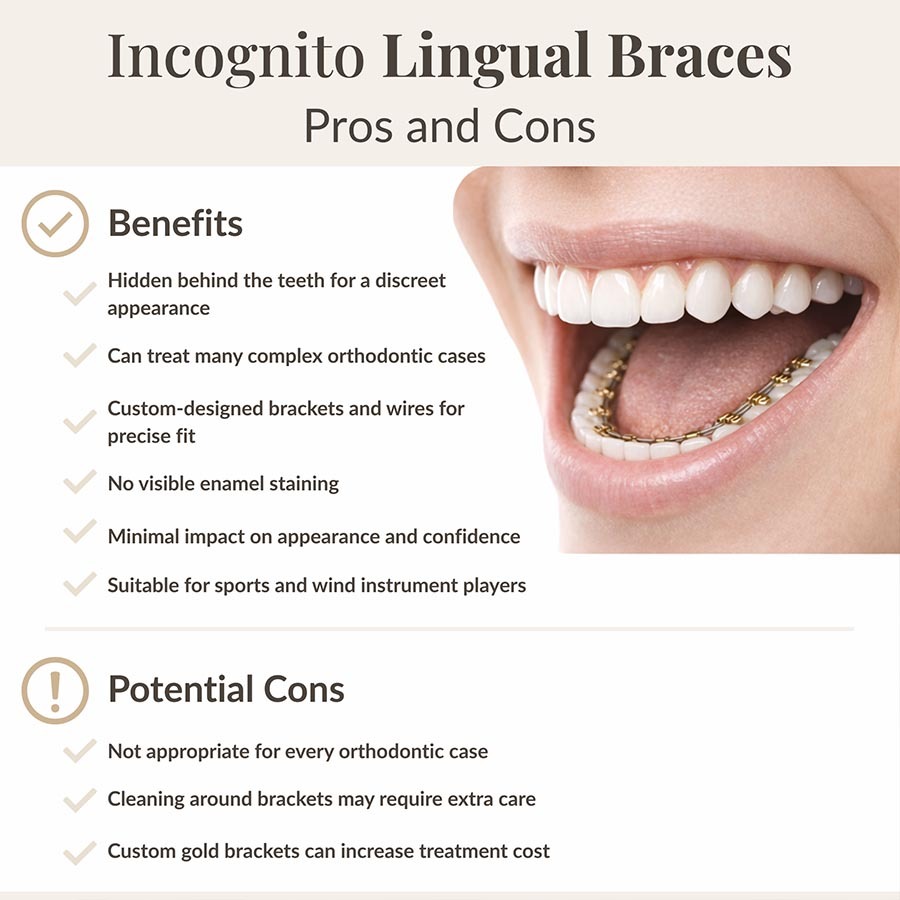
- Treatment is more discreet since the braces are hidden behind your teeth.
- Incognito braces can correct many complex orthodontic cases.
- Every brace bracket is custom-designed to fit your teeth accurately and more comfortably. The wires powering the brackets are also precision-made and tailored to your prescription.
- There is no risk of enamel staining as the brackets are fitted inside your teeth.
- Treatment will not affect self-confidence since the braces are less visible.
- Anyone who likes to play sports or who plays a wind instrument may find Incognito braces are more comfortable and convenient to use.
Potential cons of treatment can include:
- Lingual braces are not suitable for everyone.
- Additional care is needed to clean around the brackets thoroughly since they are less accessible than brackets fitted onto the front of teeth.
- Incognito braces can be more expensive because each bracket is custom-designed and made from gold alloy.
Lingual Braces vs Invisalign
While both systems offer a high level of discretion, Incognito lingual braces provide a level of mechanical control that clear aligners cannot always match. Lingual braces are compliance-free, meaning the correction happens 24/7 without the risk of lost progress due to forgotten aligners.
From a clinical perspective, lingual hardware is superior for performing heavy-duty movements, such as significant vertical tooth adjustments or correcting severe bite discrepancies, where the rigid fixity of a bracket is an advantage.
Lingual Braces
Sometimes lingual braces can provide better results than Invisalign aligners. Incognito braces can achieve more complex tooth movements effectively, and the system works continuously to straighten teeth. Treatment can be especially effective for repositioning front teeth.
Incognito is a good option for anyone likely to forget to wear their aligners, but the brackets and wires can be more challenging to keep clean.
Invisalign Aligners
The primary appeal of Invisalign is the ability to maintain a normal diet and oral hygiene routine without the interference of fixed appliances. However, this flexibility comes with the responsibility of discipline.
Because aligners must be removed for every meal and snack, the stop-and-go nature of the treatment requires strict adherence to the 22-hour daily wear rule. For patients who prefer a “set it and forget it” approach to orthodontics, the permanent placement of lingual braces often proves more practical.
Incognito Lingual Braces Treatment Process Step-By-Step
Several steps are involved, which are outlined below; however, your treatment may be slightly different, as it will be custom-designed for you.
Step One: Consultation & Imaging
An initial consultation is necessary so we can examine your teeth, including how they come together, to determine the issues requiring correction. We also discuss your aims and desires for this treatment with you.
Next, 3D imaging is used to create your custom treatment plan. It helps us design your lingual braces, including the brackets and wires.
Step Two: Creating Your Incognito Lingual Braces
After finalizing your treatment plan, computerized and robotic technology are used to create your custom-made brackets and wires.
Step Three: Fitting Your New Incognito Lingual Braces
Once your braces are ready, you return to NYC Dentistry Center so we can fit them onto the inner surfaces of your teeth. Once they are bonded in place, we will make sure they feel comfortable and discuss your oral care routine.
Step Four: Regular Checkups and Adjustments
You will need to return to our dental office regularly during your treatment so we can adjust and tighten the braces as required. We must also check that your treatment plan is progressing as anticipated, and if necessary, make any minor adjustments.
What to Expect While Wearing Lingual Braces
The adaptation period for Incognito is primarily focused on the tongue’s adjustment to the internal hardware. During the first week, patients may notice a slight temporary change in speech (lisp) and some minor tongue sensitivity as the mouth acclimates to the new contours.
However, because the brackets are ultra-low profile, the irritation to the lips and cheeks common with traditional braces is non-existent. Most patients find that their speech returns to normal within 7 to 10 days
Speaking
Any new dental appliance will initially feel a bit strange, so you may find it takes a while to become accustomed to your Incognito lingual braces and to speak with them clearly. Because the brackets are placed on the inner surfaces of teeth, it’s not unusual to have a slight lisp, but this should disappear as you get used to speaking with your braces.
Oral Care
Another consideration is oral care, as you will need to spend longer cleaning around your brackets and wires. Because they are fitted on the inner surfaces of your teeth, these brackets can be more challenging to brush and floss thoroughly. We will provide clear instructions and discuss suitable tools to help you keep your Incognito braces clean. We may also suggest more frequent cleanings during your treatment to help maintain good oral health.
Incognito lingual braces provide a fully hidden orthodontic solution by placing custom brackets behind your teeth, giving you the confidence of a discreet treatment with powerful results. Book dentist appointment today at NYC Dentistry Center to see if Incognito braces are the right choice for your smile transformation.
FAQs
Are Incognito Braces Really Invisible?
Incognito lingual braces are very discreet, but it may be possible to catch a glimpse of the brackets inside your teeth occasionally. No orthodontic system is entirely invisible, but it’s unlikely anyone will notice your Incognito braces unless they are specifically looking for them.
Are Incognito Braces More Uncomfortable Than Ordinary Braces?
Incognito lingual braces shouldn’t feel any more uncomfortable than ordinary braces. Some level of discomfort is inevitable because your teeth are being moved, but it should be easily manageable with over-the-counter pain relief. If you find the discomfort too great, please get in touch with us so we can adjust your braces to make them feel more comfortable.
Are Incognito Braces More Expensive?
These braces can cost a little more than other solutions, as the brackets and wires are custom-designed and made to ensure a comfortable and effective treatment.
6 E 45th St #801
New York, NY 10017
(45th St. btw 5th Ave / Madison Ave)
(212) 518-6096